Miwasaki is a tiny corner of the Nanki Kumano-nada coastline, squeezed
between the rough Pacific Ocean and the Kumano mountain range, like the
forehead of a cat. It's a rather apologetic piece of land. Yet, as a settlement,
it has appeared and disappeared in history since the time of Emperor Jimmu's
eastern campaign.
The town stretches narrowly along the coast, with rice paddies and terraced
fields extending inland. It was originally a town of both farming and fishing.
Some may recall director Kaneto Shindo's film “The Naked Island” (1960, Modern British Association), which depicted impoverished farmers on a small island in the Seto Inland Sea.
Shot in monochrome with no dialogue, it featured almost exclusively Nobuko
Otowa and Taiji Tonoyama. It portrayed the solitary lives of poor farmers
with a detached, documentary-like touch. It drew every viewer's eyes to
the screen, bringing tears to their eyes. It won the Grand Prix at the
Moscow International Film Festival.
In my case, transfixed by the film, my eyes sweating, I somehow recalled
helping my parents as an elementary school boy in the fields atop a small
hill. While not as tragic or harsh as “The Naked Island,” Miwasaki had
its similarities.
Back then, my parents ran a grocery store and supplemented their income
by farming the fields. My father also went fishing.
In Miwasaki, most households followed the pattern: men to the sea, women to the fields.
Every fisherman rose before dawn. They wolfed down ochazuke and headed
out to sea. The men untied the mooring lines, hoisted the sails of their
tenma boats, and set out to sea.
The women busily helped until the boats left the shore, then watched them go. After sending the children off to school, they hurried to the fields in the mountains.
My parents' fields were on a small hill very close to what is now called
the Kumano Kodo Koyasan Trail's “Miwasaki Entrance.” Turning off the ancient
trail onto a path along the field ridges, it took about fifteen minutes
to reach the fields at the top.
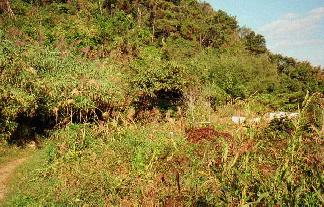
Sweet potatoes (we simply called them “potatoes”), wheat, pumpkins, peas, and all sorts of other things... we grew grains and vegetables to fill our bellies.
Looking down, the Kumano Sea stretched out below. In a spot with a good view stood a summer mandarin orange tree, which bore fruit heavy with ripeness when the season came. They were sour and awful.
It was just around the time Masako Kawada's song “The Hill Where Mikan
Blossoms Bloom” started being sung, and even now, I associate the lyrics
with this very field.
みかんの花が 咲いている
思い出の道 丘の道
はるかに見える 青い海
お船がとおく 霞(かす)んでる
Mikan blossoms are blooming
The path of memories, the hill's path
The blue sea visible far away
Ships far off, hazy
The mountain path to the field was a narrow ledge, barely wide enough for
one person to walk along. My parents carried loads on a balance pole along
that path, going back and forth. My sister, brother, and I would also go
to help after school.
It was pure luck no one fell off the cliff. It was tough (exhausting),
but my parents' exaggerated praise made us ecstatic.
Winter wheat trampling was brutal. My feet went numb (froze). The biting wind swept across the exposed fields.
In summer, carrying the balance pole up and down the fields to the fields was enough to give you sunstroke. Sometimes, the barley rice we ate at noon had ants crawling all over it.
“You know, ants are incredibly strong creatures. That's why, even if it's
not tasty, it's nourishing.”
That was my father's favorite saying.
Suzushima and Kushima Islands
Just a stone's throw from the shore in front of the fishing cooperative, two small islands float. The left is Suzushima, the right is Kushima. A bridge (caisson) connects the two, but children used to swim across to either island.
Suzushima, where two pine trees ostentatiously vie for beauty. Dive beneath
the island's perimeter, and you'll find abalone, sea urchin, shrimp,
and coastal fish teeming.
Kushima, covered in pine and mixed woodland. A small shrine enshrines the
guardian deity of fishermen. ... Former sumo wrestler Kushima-umi is the
son of Kushima-san, the geta sandal shop who managed this island for many
years. Kushima-umi's parents moved to Shingu.
The view from both islands looking back at the Kumano-nada coast, stretching from Miwasaki to Sano, isn't bad either.
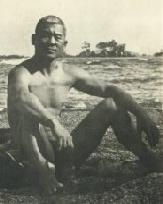 |
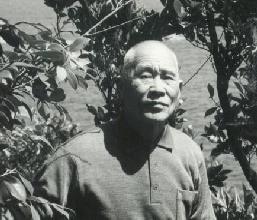
My father around
the age of 50
(Suzu-shima Island
in the background) |
My father was a master free diver. From the age of sixteen, he spent seventeen
years diving for pearl oysters in the Arafura Sea, north of Australia near
Papua New Guinea. Drawing on those past skills and using a bamboo speargun
he invented himself, he brought the bounty of the sea from around Suzushima
to our table day after day.
Miso soup with chunks of shrimp was an offering from the shore, as was
vinegar-marinated abalone liver. The taste remains unforgettable.
My father was also a master at finding sea turtle eggs while walking along
the sandy shoreline. When I was in elementary and junior high school, we'd
eat boiled turtle eggs over warm rice... breaking two or three eggs, cracking
their soft shells, and letting the contents fall onto the rice. A little
soy sauce drizzled on top, then stirred with chopsticks. After that, it
was just a matter of huffing and puffing while devouring it. How incredibly
delicious it was.
Nowadays, walking along the beach with a bamboo stick in hand searching for turtle eggs is probably forbidden.
One more thing. My father loved turtle meat. Our family did too. Turtle
meat sukiyaki – I've never known anything quite so delicious since. This
is a true story. ...However, they say eating this meat forces every virus
in your body to come out, so apparently some people didn't want to eat
it.
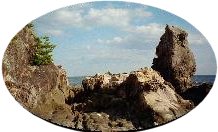 |
| Off the coast of Suzushima lies the rough sea of the Pacific Ocean |
Now, the two small islands bear no trace of their former selves.
The pines of Suzu Island have already withered; only a few bald trees faintly
hint at the past.
Kushima Island, too, has lost its lush greenery. Only a few beach cotton
plants bloom.
The fishermen's guardian deity looks lonely beyond the vermilion torii
gate, its paint peeling away.
Large-scale land reclamation, fishing port renovations, from oar-powered
tenma boats to steamboats... Efforts to stem depopulation went unrewarded,
while nature alone changed completely.
…………
Yet the sea at Miwasaki remains as captivating as ever. A noisy sea contrasting with the town's quiet. The rocky shores and small islands reveal their rugged forms through the crashing waves. Fishing is still thriving. In summer, the sandy beaches bustle with swimmers.
Cultivated Fields and Rice Paddies
The mountain fields I tended until junior high were passed on to someone
else long ago.
The potato field that always won first prize for size at the agricultural fair. The summer oranges, sour but perfect for quenching thirst. The slope along the way where snakes often appeared, terrifying me.
I wonder what they look like now.
The rice paddies where I helped my father with double cropping from middle
school through high school are now a residential area. Since our ancestral
graves are just a little further on, I pass here every time I return home.
The pain of weeding in the scorching summer sun in those paddies still
comes back to me. Leeches clinging to my legs everywhere—it was so disgusting.
On the way back from the fields, I often picked water dropwort with my mother along the embankments. Whether boiled or added to miso soup, it smelled wonderful and tasted delicious.
The narrow path where I pulled the handcart back and forth still faintly holds traces of the past.
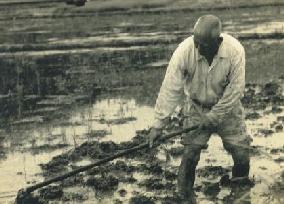
“The soil is alive too, you know.
It's not like having a cow plow it!” |
The Four Seasons
After the Pacific War, when I was in elementary school (around 1950). Miwasaki
was like this.
Spring
From March, it warms up and the cherry blossoms start to bloom. It rains often. When the cherry blossoms fall, the satsuki azaleas and common azaleas bloom. The slopes leading to the mountain fields become covered in weeds. The Japanese knotweed grows thick. It brushes against your hands and feet, causing scrapes that draw blood. The grassy scent was in the air. Do you know a vegetable called “gonpachi”? It was delicious boiled and eaten plain, or added to stews.
From the time of the carp streamers, the weather turned into that crisp,
clear May sunshine. It grew hotter day by day.
On Saturdays, after school ended, my siblings and I would chatter and laugh
as we walked along the coastal road to the foothills on the outskirts of
town. It took about 20 minutes to reach the spot where the tunnel came
into view. We crossed the railroad tracks and crossed the stone bridge
over the “Shirakawa” (Grass River?). Just above, in the shade of the trees
on the mountain, our parents waited with lunch prepared. It was a ledge
about two and a half tatami mats wide halfway up the slope, our spot for
lunch and relaxation.
Wiping sweat from our brows, we climbed the steep mountain path. We all
called out in unison,
“Daddy~! Mommy~!”...(echoed by the mountain god)
From above,
“Kids~! Watch your step~!”...(echoed by the mountain god)
Summer
Looking down from the mountain fields over the heavy summer mandarin orange
trees, Suzushima and Kushima islands float in the cobalt blue sea. The
Ugui Peninsula juts out to the west. The sky is aqua blue. The blazing
sun beats down relentlessly.
Pure white waves sparkle here and there, leaping and weaving striped patterns. Just below, the rough waves crash against the rocky reef, thudding and thundering.
I forget the beads of sweat dripping from my straw-hatted face, mesmerized. Behind me, Father calls,
“Shigeru~! Staying out in the sun too long will give you sunstroke!”
Autumn
After the sweet potato harvest and rice cutting in the fields, the town holds the grand autumn festival at Hachiman Shrine.
The Danjiris of mikoshi portable shrines, Ebisu- Daikoku, and the Twenty-Four Filial Exemplars (called Nijihiko) floats representing parade through the narrow streets. The highlight is the clanging and crashing of the danjiri as they jostle, fueling the town's once-a-year excitement. On the sandy beach, the young men's “Whale Dance” brings the festival to its peak.
Every household parades sushi made with great care. Whole mackerel sushi
, seaweed rolls, kelp rolls, deep-fried tofu...
When I entered junior high, my father started farming rice fields. One tan (about 1,650 square meters) yielded eight bales of rice. We used no oxen for plowing; everything was done by hand with a plow, hoe, and shovel. It was hard work, and I hated helping.
Leeches bit me, which was a real pain. I struggled to pull each one off.
Snakes swam in the water. Sparrows, locusts... we were plagued by tiny
pests. I'll never forget the exhilaration of diving into the nearby
river.
Soon after, my father started double cropping. We harvested nearly 15 bales
of rice in total. It became known as “the first double cropping in Wakayama
Prefecture.” But my hardship doubled.
Winter
Snow rarely fell, but the wind was bitterly cold. The rain is cold. The sea is rough.
Even so, my father loved rowing his tenma boat out to sea. My mother would go to the mountain fields. We children, dressed in our hanko (padded coats), would help her. The hanko were made by my mother, sewing late into the night.
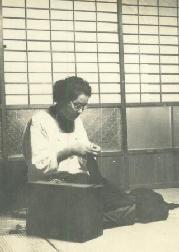
On New Year's Day, before dawn, we would visit the Hachiman-sama (Hachiman Shrine) on a small hill. We would clasp our hands together in prayer at the first sunrise over the sea.
|