3. Miwasaki in the Manyo-shu

From Miwasaki to Sano to the west, Kuroshio Park stretches along the coast. It was created by reclaiming land from the shallow sea. I often swam here as a child, and it was also a spot for dragnet fishing. Now it's a playground for children and a place of rest for the elderly.
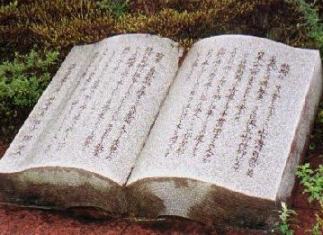
At the park entrance stands a stone monument inscribed with the following words.

Kumano has long flourished as the spiritual homeland of the Japanese people, cherished for its magnificent natural beauty of mountains and sea, its ancient and distant history, and the profound faith in the Three Sacred Mountains.

Along this ancient pilgrimage route to Kumano, many people traveled in the Middle Ages, each carrying their own prayers and thoughts. Travelers who stood at Miwa-ga-saki and Sano-no-Watari gazed at the moon through the pine branches, reflecting on their journey thus far, and contemplated their future as they watched the waves wash ashore. They composed countless poems.

Since then, countless springs and autumns have passed. Though the modern landscape bears little resemblance to the past, the immortal verses of those ancient poets perfectly capture the beauty of our bygone homeland and the spirit of Kumano. ...(rest omitted)

石碑

Few people know Miwasaki is mentioned in the Manyo-shu. It's only natural, since it's an obscure place...

Kuroshio Park, overlooking the Kumano Sea, is a playground for children, a resting place for the elderly, and for me, the perfect spot to boast about my hometown.

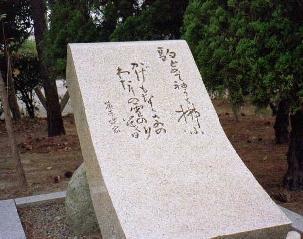
Within the park stand several Manyo-shu poem monuments, all celebrating Miwasaki and Sano. Let me introduce them.

苦しくも 駒とめて
苦しくも 駒とめて わすれずよ
神の崎 みわが崎
神の崎 みわが崎
三輪が崎 やどもがな さみだれは
三輪が崎 やどもがな さみだれは

Many people are likely familiar with the following poem from the Shin Kokin Waka-shū.

駒とめて袖うちはらふかげもなし
佐野のわたりの雪の夕暮れ

       (藤原定家)

歌碑
  
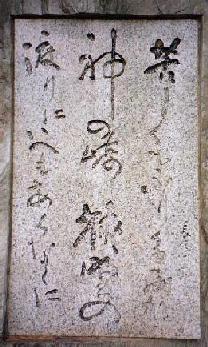
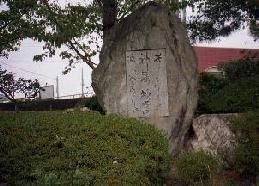
This original poem appears in the Manyo-shu, and Miwasaki makes an appearance.

苦しくもふりくる雨か神(みわ)が崎
狹野(さの)のわたりに家もあらなくに

    長忌寸奥麻呂(ながのいみきおきまろ)

I would like to quote the interpretations of two experts.

歌碑Saito Mokichi (Man'yō-shū Masterpiece)

God's Cape (Miwa-saki) lies on the coast of Higashimuro District in Kii Province, while Sano is located southwest of it; both are now incorporated into Shingū City.

“Watari” refers to a ferry crossing. The heart of this poem likely lies in the second line, where the lament “Is this rain falling?” carries a tone of supplication.

Because the heart is expressed straightforwardly and is accepted without strain, it has been valued since ancient times as a masterpiece of the Manyo-shu.

Indeed, there exists a song by Fujiwara no Teika, a master of honka-dori (taking the main verse), that echoes this sentiment:

“Halting my horse, I brush my sleeves— Not even a shadow remains At Sano's crossing, snowy dusk.”

This shows how ordinary the emotion itself is, yet Okimaro, having traveled the route himself, was able to compose such a song.

It is not comparable in nature to Teika's imaginative imitation songs.
歌碑Murase Norio (Manyō no Uta, Volume 9)

The author, Naga no Imiki Okimaro, along with Kakinomoto no Hitomaro and Takaichi no Kuroto, is a representative court poet of the second period of the Manyō-shū.

The Naga clan is thought to be of immigrant origin, as indicated by their surname Imiki.

It is also said that the Naga clan likely derived its name from its ancestral seat in Naga District, Kii Province.

Indeed, Miwasaki and Sano in Shingu City were remote areas at the time, beyond the reach of imperial visits. One might wonder why a court poet would travel to such a place.

However, if the Naga clan truly had Naga District as their ancestral home, it is entirely plausible that Imiki Okimaro would have wished to leave his mark on this land, separate from any imperial visit.

Above all, the landscape of Miwasaki and Sano perfectly suits the content of the poem. This coastline, forming a crescent arc facing directly out to the Kumano Sea, offers no barrier against the waves or wind.

Rushing waves crash against the rugged shore, raising spray and blocking the way.

Add to that the heavy, violent rains of Kumano, and one can only tremble before the threat of nature.

Reading (10:05) on

Total Reading 53:07
Originally Written in Japanese
in the year of 2004

Translated into English under the the help of DeepL
January 6, 2026
< Part2
Back Then
Miwasaki
Cover >
Japanese English
Close  閉じる