|
My driver's license lists my registered domicile as: Miwasaki, Shingu
City, Wakayama Prefecture, my address.
Miwasaki in Shingu City, located in the Nanki region of Kii Peninsula within
Kumano area, is my hometown. However, since graduating from Shingu High
School (1959, 11th graduating class), I've been far away.
Though part of Shingu City, Miwasaki feels like a practically independent
town. Administratively it's incorporated into the city, but geographically
it seems forced together. Even with today's developed transportation,
its culture, dialect, and living environment remain distinct from the city
center.
Like most places, Miwasaki Town, which seemed infinitely vast to me as a child, is barely a dot on a national map. Turning to the Wakayama Prefecture page and peering at it with a magnifying glass, its name catches your eye, tucked away in a small corner along the coast of Shingu City, facing the Kumano Sea and bordering Mie Prefecture.
Until shortly after the war, it was known as Miwasaki Town, Higashimuro
District, Wakayama Prefecture. It was later incorporated into Shingu, becoming
Miwasaki, Shingu City. The JR Kii Line station retains the name “Miwasaki,”
but it has quietly become an unmanned station.
The southernmost point of the Kii Peninsula is Cape Shiono-misali, jutting
out into the Pacific Ocean from Kushimoto. Needless to say, it is the southernmost
tip of Honshu. The Kuroshio Current crashes its rough waves against the
cliffs.
Across from Kushimoto lies Oshima Island, famous in folk songs. Nearby
is Hashikui Rock, a scenic spot featuring a chain of bizarre rock formations.
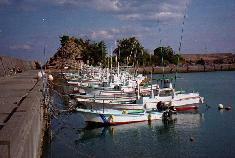
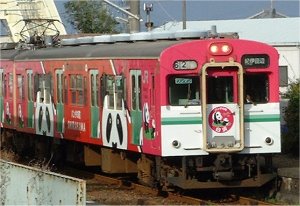
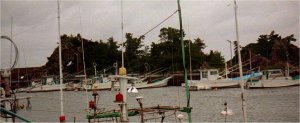
Miwasaki is a coastal fishing village reached by a 30-minute ride east along the Kumano-nada coastline from Kushimoto Station on a diesel train.
Since ancient times, it has formed a single settlement together with its western neighbors, Sano and Kinokawa. The combined population of these three districts is only about 5,000. The entire city of Shingu, which includes these three districts, has a population under 40,000 (as of 1999).
One station east of Miwasaki is “Shingu.” It marks the easternmost point of Wakayama Prefecture and the border with Mie Prefecture.
Miwasaki and Shingū are separated by a mountain range (about 10 km), so despite being in the same Shingū City, their dialects differ significantly. Before the railway opened, there were also few marital ties between the two areas.
Around 1960, Emperor Shōwa traveled by car from Ise across the Kii Peninsula
towards Wakayama. At that time, the road (Route 42) was remarkably improved
and paved, greatly enhancing transportation access.
Directly south of the Kii Peninsula, protruding into the Pacific Ocean from Kushimoto, is Shionomisaki Cape, unquestionably the southernmost point of Honshu. The Kuroshio Current crashes its rough waves against the cliffs.
Opposite Kushimoto lies Ōshima Island, famous in folk songs. Nearby is Hashikui-iwa, a scenic spot featuring a chain of bizarre rock formations.
Today, driving along National Route 42 centered on Miwasaki, you'll find famous scenic spots and historic sites clustered within a radius of less than an hour's drive.
Nachi Falls, Kumano Nachi Taisha Shrine, Seigantoji Temple, Kumano Hayatama
Taisha Shrine, Mt. Kamikura, Katsuura Onsen, Yukawa Onsen, Taiji Whale
Sanctuary, Shionomisaki Cape, and Onigajo Castle in Kumano City.
If you drive a bit further north, you'll find Dorokyo Gorge (the so-called
Dorohatcho), Kumano Hongu Taisha Shrine, and hot spring towns like Kawayu,
Yunomine, and Watarase...
Compared to these numerous scenic spots, Miwasaki tends to be overshadowed,
seen as unremarkable...
Is that really so? I think there are quite a few hidden scenic spots and historical sites here. I'm biased, of course, since it's my beloved hometown.
“It's a wonderful town. It has the sea, mountains, countryside, and
the history of the Manyo-shu (Collection for a Myriad Ages). There's
even the Kumano Acient Road pilgrimage route. I really want you to come
see it! Please!”
For Getting to Miwasaki
Around 1960 (Showa 35), during an imperial visit by Emperor Showa, National Route 42 was improved and paved, running from Nagoya along the Kii Peninsula coast to Osaka.
Located near the southern tip of the peninsula, Miwasaki became easily accessible by car from both Nagoya and Osaka.
By train, it's now about four hours from Shingu to either Osaka or Nagoya on the diesel limited express.
The JR “Kii Line” circles the coast of the Kii Peninsula from Osaka to Nagoya, passing through Tanabe, Shirahama, Kushimoto, Kii-Katsuura, Nachi, and Shingu in Wakayama Prefecture, and Kumano City, Owase, Matsusaka, and Yokkaichi in Mie Prefecture.
Mountain ranges, plum and mandarin orange orchards, and the cobalt blue
of the Kuroshio Current stretch endlessly.
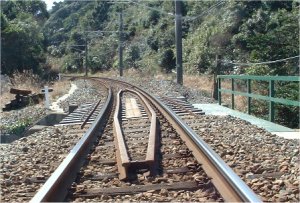
The railway tracks remain a single line to this day.
In 1959 (Showa 34), before the Kisei Main Line was fully connected between Shingu and Nagoya, my route to Tokyo for university entrance exams was...
I innevitably took the D-51 locomotive (Degoichi) all the way to Osaka,
about 10 hours (at the time), heading in the opposite direction, then used
the Tokaido Line from Osaka to Tokyo. The whole trip took nearly 20 hours.
After a year of retaking the exams, in 1960 (Showa 35), when I headed to Tokyo again, the Kisei Main Line was fully open. This time, I went directly to Tokyo via Nagoya, bypassing Osaka. I was overcome with joy. The trip to Tokyo was shortened by over five hours.
What's more, by this time, the D-51 had almost completely disappeared,
and all limited express and express trains had switched to diesel.
The days of my eyes bloodshot and my nose blackened from the coal smoke billowing in through the D-51's windows are now a thing of the past.
As of 2004, the journey from Tokyo to Miwasaki takes about 6 hours.
Tokyo → Nagoya (2 hours, Shinkansen Hikari), Nagoya → Shingū (3.5 hours, Limited Express Nanki), Shingū → Miwasaki (5 minutes by train, 15 minutes by bus)
Until that time, most young people in Miwasaki became fishermen or farmers after finishing compulsory education, following in their parents' footsteps. The rest went to Shingū to work for lumber companies or became shop clerks.
This pattern was disrupted by the full opening of the Kisei Main Line in
1960 (Showa 35) and the major paving of National Route 42 in 1965 (Showa
40).
Coupled with the decline of Shingū's lumber industry, young people began leaving for the cities immediately after graduating junior high or high school. They weren't just heading only to Osaka anymore; they started finding jobs in Nagoya and Tokyo too.
Miwasaki remained a town of part-time farmers and part-time fishermen,
but the young people grew fewer and fewer with each passing year.
“The young folks just don't stick around anymore, you know~”
|